Seasonal stories / NINEHOUND JOURNAL
Celebrity Traitors returns for series two: why do we love hunting the traitor?
Why can viewers never get enough of a show where lying can win money? Because it makes reading people a game. The Faithful must expose disguises; the Traitors must perform sincerity. It enlarges a problem of ordinary social life. What we watch is people.
Article
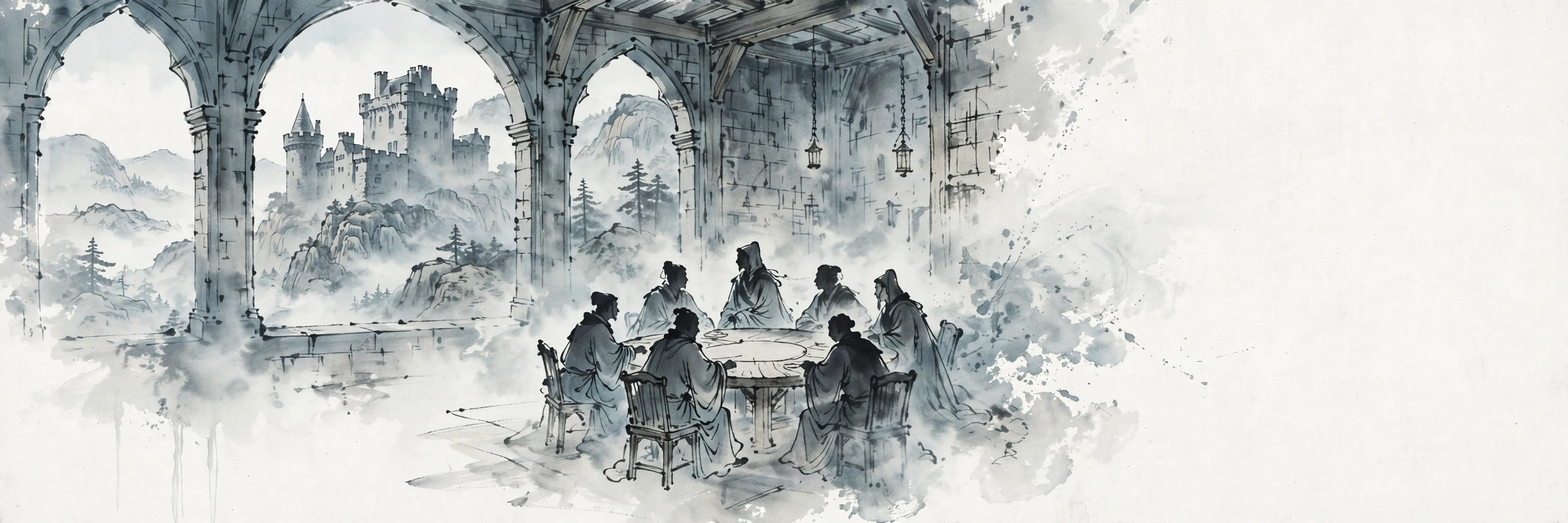
Why can viewers never get enough of a show where lying can win money? Because it makes reading people a game. The Faithful must expose disguises; the Traitors must perform sincerity. It enlarges a problem of ordinary social life. What we watch is people.
The BBC’s Celebrity Traitors began its second series at 8 p.m. on October 1 on BBC One and iPlayer, with twenty-one celebrities entering Ardross Castle in Scotland and episodes each Thursday and Friday. Its rules continue from series one: a few Traitors hide among the Faithful, “murder” one player at night, and join the daytime vote to banish a suspect. Up to £100,000 goes to charity. Alan Carr won the first series as a Traitor, becoming an example of deceiving everyone to the end. The second lineup includes Michael Sheen, Bella Ramsey, Maya Jama, and James Blunt. Before play, internet personality and boxer King Kenny admitted that people who know him can spot his lies immediately, “but with strangers, perhaps it is different.”
Traditional discussion of reading people concerns just this problem. The Analects advises looking at what someone does, how they proceed, and where they feel at ease; physiognomic traditions speak of inner sincerity taking outward form. What a person holds within may eventually emerge through speech and action. The show captivates at those supposed moments of leakage: a Traitor’s extra half-second before voting, the flushed face of a wrongly accused Faithful, a glance toward an ally. Viewers have information the players lack and pass judgment as they watch. The pleasure of feeling clear-eyed while everyone else is confused is part of its appeal.
The game must, however, be distinguished from life. A closed castle, high pressure, and surrounding cameras create an unusually compressed situation, with tiny expressions magnified dramatically. Understanding people outside it takes much longer. Traditional advice emphasizes prolonged acquaintance: distance reveals a horse’s strength, time reveals a person’s heart. Judging someone in three seconds belongs to the showman’s pitch, not careful reading. King Kenny’s remark identifies another point: familiar people know your baseline, making deviations conspicuous. The article reads that as a reason producers favor celebrities who are neither wholly familiar nor complete strangers: excessive familiarity makes deception difficult, while complete unfamiliarity removes personal stakes.
The show’s lasting appeal thus lies in reflecting our own social judgments: every day we assess whom to trust and who is performing. It moves that ordinary task into a castle and adds prize money. Its best lesson should not be how to lie undetected. It should be a better sense of the folds in human behavior: apparent sincerity can sometimes be the strongest disguise, and uncovering it takes time rather than a clever trick.
The first series offers a case worth revisiting. Alan Carr remained a Traitor to the end, deceiving David Olusoga and Nick Mohammed at the final table and winning. His effectiveness, in this reading, came from performing harmlessness rather than spectacular acting. Traditional advice warns that great deceit can resemble loyalty. The best disguise need not be flawless; it can make you think there is no reason for caution. Carr’s comic role encouraged that impression: who suspects the person simply providing jokes? By the time the others recognized it, the win was his. The Analects’ warning that clever speech and a pleasing countenance rarely signal benevolence gains an ironic echo: the most dangerous person in the game may be the one who least appears to fit that description.
Three phrases in the Analects, “For Government,” summarize this approach: observe what someone does, how they proceed, and where they are at ease. The article renders them plainly as looking at actions, reasons for those actions, and whether the person feels at ease afterward. The show turns these into mechanisms: round-table votes display actions, night murders illuminate motives, and responses to accusations suggest where players feel secure. Informed viewers judge as they watch, enjoying a sense of clarity denied to the players. King Kenny’s pre-game comment—that familiar people spot his lies, while strangers may not—again identifies the baseline issue: knowing someone’s ordinary manner helps expose departures from it.
Yet the distinction between game and life remains. A sealed castle, intense competition, and cameras magnify expressions; knowing people in daily life takes longer. The traditional proverb about distance and time favors patience, while an instant three-second verdict is a showman’s promise. The worthwhile lesson is understanding complicated behavior, rather than learning to lie unnoticed. Sincerity can be performed, and seeing through the performance depends on time. The twenty-one celebrities scheming in the second series launched on October 1 reflect the judgment we make every day about trust and performance. The show gives that familiar task a castle and a prize.
Sources and further reading
- The Celebrity Traitors, series 2 — Wikipedia ↗
- The Celebrity Traitors, series 1 — Wikipedia (search excerpts only) ↗
- Capital FM / Sunday Guardian Live (search excerpts only) ↗
- Event: BBC’s The Celebrity Traitors, series two, premiered on BBC One and iPlayer on October 1, 2026, with twenty-one celebrity contestants, Thursday and Friday episodes, and up to £100,000 for charity.
- Source: Spectrum FM (spectrumfm.net), report dated October 1, 2026.
The article’s views and source references are provided in the text and the links above.